Showing posts with label ghost stories. Show all posts

Saturday, 8 June 2024

An Urban Legend from Baie Verte, Newfoundland


I wouldn’t turn down $150, but I’m not sure I’d return from the great beyond to watch over it. 

When I hear a story about a ghostly guardian protecting some kind of treasure, it is usually about a chest of gold or something of substantial value.

The community of Baie Verte, just to be contrary, has a local urban legend about a cheap ghost haunting the old Roman Catholic cemetery on Barn Hill.

Children in the town were told to stay out of there because it was haunted by an old man who was buried there years earlier with $150 dollars in his pocket.

It was claimed he haunted the place to protect his money.

- Dale Jarvis

Listen on TikTok

Saturday, 9 September 2023

The Haunting of Rohan's Cottage, Harbour Grace, NL

If you had a horn that could summon spirits from the underworld, would you risk blowing it? 

One gentleman in Newfoundland claimed to have done it frequently.

This is the story of Rohan’s Cottage.


Thursday, 31 August 2023

Pirate Ghosts in Lolly Cove, Fortune Bay

A strange looking ship entered Lolly Cove, Fortune Bay, crewed by dark, foreign men. Locals watched as they marched to the outskirts of town. There, the men turned upon two of their crew, dispatching and burying them on the spot. 

With the grave filled in, they departed, and as they did so their ship vanished away. 

Afterwards, the townsfolk could not find the freshly dug grave, finding instead a slight depression in the earth, much grown over, untouched for centuries.

Monday, 26 September 2022

A strange light haunts the waters near La Scie, Newfoundland: Jack the Lantern of Shoe Cove Bight.

Not far from La Scie, Newfoundland, is the former community of Shoe Cove Bight.  The Bight was said to be a favourite stomping ground of a supernatural phenomenon which locals know as Jack the Lantern. Storyteller and author Dale Jarvis shares the tale of what happened when a group of boys rowed home one September night from La Scie to The Bight.

Wednesday, 21 September 2022

The Haunting of Lunenburg Academy, Nova Scotia


Lunenburg is said to have more folklore, witches, and superstitions than any other place in Nova Scotia. Of all its sinister places, the Lunenburg Academy is definitely the most famous of the historic town's many haunted buildings. 

The Lunenburg Academy was built in 1895, and operated as a school continuously to 2012. It stands on Gallows Hill, close to the Hillcrest Cemetery, dating back to the 1700s.

Years ago, a carpenter working alone in the school felt the hair on the back of his neck stand up. Turning around he saw the vision of a man, strung up by his neck, before it vanished.

The building’s basement was nicknamed The Dungeon by students, thanks to an evil feeling pervading the space and rumours of a dark creature inhabiting one of the toilet stalls. More recently, a film crew captured the image of a face in the window of the Academy. When the image was circulated, it was identified in a school yearbook as Mr. Sidney Knickle, a past custodian and caretaker.


Sunday, 10 July 2022

The cooper's ghost of Port de Grave, Conception Bay, NL


Long after his earthly passing, one Port de Grave man can still be heard hard at work. 

One of the most important side-hustles in a busy fishing community like Port de Grave was barrel-making. Wooden barrels were needed for transporting fish and other goods; even berries were exported in herring barrels. Skilled coopers were always needed, and many outport fishermen augmented their meagre yearly earnings making barrels or supplying materials for the cooper’s trade. 

According to legend, one of Port de Grave’s coopers did not let his own passing interfere with his enterprise.

After his burial, locals claimed that the sound of the cooper knocking the hoops onto the barrels could be heard ringing mysteriously through the night air.

Listen on TikTok


Thursday, 7 July 2022

The Devil Himself, in Locks Cove, Hare Bay.


At the bottom of Hare Bay, Newfoundland, there is a little spot called Locks Cove, known for strange and unexplainable happenings.

Years ago, a crew just off the fishing grounds were bunked down in an old fishing stage in Locks Cove.

They got in, had a mug up, and settled down for the night. They lashed the door shut with trawl line, and retired for a few hours sleep.

It was a calm clear night, without another living soul for miles.

At 3:00 in the morning, they woke up to the sound of something pounding at the door. Then, the door, which had been tied tight with trawl line swung open.

When they got up to investigate, they saw that line, strong enough for the heavy work of hauling fish, had been snapped like a thread. All was calm, still and silent, without a breath of wind. They quickly gathered their belongings, jumped in their boat and never looked back.

Years later, one of those old fishermen said that whatever was strong enough to bust a trawl line, was not something to be messed with. He added,

"It must have been the devil himself."

View the story on TikTok here

Have a story from Hare Bay? Let me know at dale@dalejarvis.ca


Monday, 23 May 2022

Fredericton, NB's Tomato Soup Ghost


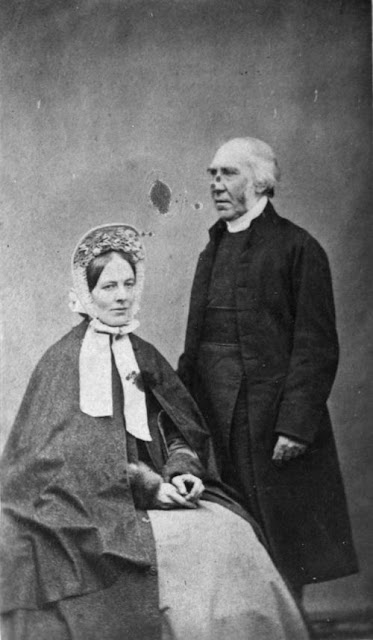
The second wife of Bishop John Medley, first Bishop of Fredericton NB was Margaret Hudson Medley. Well educated and independent, she was a choral singer, gardener, botanist, lithographer, horseback rider, and ice skater. It was rumoured that prior to her marriage she served alongside fellow nurse Florence Nightingale in the Crimean war.

Margaret survived her husband and was fiercely protective of his reputation. When she passed in 1905 at the age of 84, she was entombed beside him beneath the Cathedral's elaborate east window. 

Busy as she had been in life she did not rest long.

Reports circulated of a woman in a white dress floating through the grounds. The first written account appeared in 1975 when a worker reported a veiled spirit walking down Church Street and entering via the west door.

Most often, Margaret is seen seated or kneeling in prayer, but she is also partial to playing the church's magnificent pipe organ.  To this day she still walks the path from their house to the Cathedral bringing her husband supper, as there have been numerous inexplicable incidents of people smelling tomato soup.

She has also been spotted standing at the pulpit as if delivering a sermon, a fitting spot to spend eternity for a bishop's wife.

Listen to the story on TikTok


Monday, 6 April 2020

Exciting news! Haunted Ground ebook is on sale this week for just $4.99!


Our friends over at Flanker Press have announced that for this week (April 6 - 12), all e-book versions of Haunted Ground are just $4.99!  

In this collection of ghostly tales, I will introduce you to old legends, including spectral Viking longships, encounters with ghostly ferrymen, and strange voices on the trapline, while exploring classic elements of local folklore such as tokens and premonitions, bad weather lights, and the Old Hag herself. In addition to historical tales, you will also come face to face with some of the province’s eeriest urban legends, from the mysterious Red Eyes of Glovertown, to the chilling west coast Webber, to the Phantom Drummer of Conception Bay North. With leaping witches, dancing devils, phantom locomotives, and even a ghostly kitten or two, there is no mistaking that you are exploring truly haunted ground. 

You can find your copy here: 

Kobo

Amazon

Barnes and Noble

Apple


Thursday, 25 October 2018

The Ghost Ship of the Bay of Islands - A Hallowe'en tale for #FolkloreThursday


The Ghost Ship of the Bay of Islands
By Dale Jarvis
Ghost ships have a permanent berth in the folklore of Newfoundland and Labrador. They sail out of the night or emerge from stormy seas in countless harbours across the province. Yet while many a port boasts a ghostly galleon of its own, they are few phantom ships as mysterious as that of the Bay of Islands.

The vessel was first spotted several generations ago. Along the shores of the bay lived an old Native American woman in a small cabin. She lived alone, far from the nearest settlement, and was more than content with her life of solitude.

One evening, the woman's peaceful stretch of shoreline was disturbed by a strange series of noises. The night was filled with the sounds of a ship close by. The woman could hear the sound of men shouting orders, the sound of water lapping against its hull, the sound of ropes twisting under strain.

Amidst these noises she could make out another noise. This was a sound more troublesome: the echo of clanking chains, of men in iron fetters. A slave ship had taken shelter in the bay.

Certainly the Bay of Islands is no stranger to sailing ships. Captain Cook charted its waters, finding the bay an excellent base when he visited the coast in 1767. Cook was marine surveyor of Newfoundland from 1763 to 1767. His detailed charts made life safer for mariners, and he made maps so precise they were usedby generations of seafarers afterwards. Pirates too had ventured into the bay, seeking safety from storms and from those who sought to bring them to justice.

But a slave ship was something rare, and unheard of in the woman's lifetime. Years had passed since the last slaver had made its run between Africa and the New World. The appearance of such a ship now bode no good.

The woman opened the door to her small cabin and stepped out onto the beach. From there, the sounds of the ship were louder. She looked out onto the waters of the bay and was startled by what she saw.

The evening sky was clear, and a sliver of moon and twinkling stars shone down on a empty bay. No ship graced its waters. For as far as she could see in any direction, she was alone.

The noise did not stop however. It was as if a ship lay at anchor just in front of her, but was hidden behind some invisible veil. Clearly, a ghost ship had sailed into the bay from points unknown.

Such a dramatic and eerie haunting would no doubt provoke a feeling of great terror in the hearts of many. But the old woman had lived a long life of self-sufficiency, and had seen much in her day. No ghost ship was going to scare her. After the initial surprise of the encounter wore off, she took matters firmly and decisively into her own hands.

She disappeared back into the sanctuary of her cabin for a moment, only to re-emerge holding in her wizened hands an ancient shotgun. She marched down to the edge of the beach without any sign of fear. Raising the gun to her shoulder, she took aim at the general area where the slave ship seemed to be, and fired a mighty volley into the nothingness.

The shot reverberated throughout the night, and then died away. The air resumed its normal stillness, and the clanking and groaning of the slave ship could be heard no more.

Satisfied at the outcome of her attack, the woman slung the shotgun over her shoulder, and marched back into the cabin. She bolted the door behind, and hung the weapon in its usual place from the one of the cabin's exposed beams. She then extinguished the oil lantern she kept by the bed, and went to sleep, untroubled by any further ghostly troubles, phantom ships or mysterious noises.

When the sun rose and spread its warm light across the waters of the bay, the woman rose as well. She left her cabin and once more made her way down to the water's edge.

The water was as calm and as devoid of ships as it had been the night before. She stood still for a moment and tilted one ear to the water, but no noise out of the ordinary could be heard. Soft waves licked the smooth stones which defined the curving line of the beach. Looking into the water, the woman noticed something peculiar within easy reach. She stooped down, and thrusting her hand into the coolness of the bay, withdrew the object from its watery bed.

Rusty and weathered, with weak links and missing pieces betraying its venerable age, was a set of iron manacles.

While the slaving vessel was not seen again, the woman held on to the physical proof its visit for many a year. She would share the story with those rare visitors to her cabin, and would pull out the old manacles as an indication of her honestly.

Forty or so years ago, the woman, grown ancient with the passing of time, told her story to a young boy, and showed him the manacles.

The boy grew in a man, but never forgot what he had seen or heard.. Years later, he told they story to his son. In turn, his son told the story to me, and now I have passed it along to you.

When the wind dies down and the night grows quiet over the Bay of Islands, and the moon has diminished till it is just a sliver of its former self, listen carefully.

photo courtesy Old Book Illustrations.

Sunday, 23 July 2017

The Moving Mop and the Mystery Lady of the Twillingate Lighthouse.

Aerial view of Long Point Lighthouse in 1991
Photograph courtesy Canadian Coast Guard

The Moving Mop and the Mystery Lady of the Twillingate Lighthouse
By Dale Jarvis

The lighthouse buildings at Long Point were constructed in 1875 with the light first lit in 1876. The Long Point light has attracted a few strange stories over the years, but the most curious involves an old mop. This common, household object was kept at the base of the tower. It was not a kitchen mop, but an old tar mop: a long handled mop with a round, brush-like head. It was apparently designed for tarring a roof, but it was never used for that purpose.

When a new light keeper arrived at the light in 1980, he was told by one of the light keepers who had been there for a long time that this tar mop had always been there. The tar mop sat, resting on the bracket that supports the bottom part of the staircase. The reason why it was never removed from the premises was that for some reason it has a strange tendency to move around, all by itself.

According to reports the mop was known to reverse its position on the bracket. One day it would be shoved in facing one way, and the next day, or two or three later, it would be shoved in facing the opposite direction. There was no explanation for who did it, how it happened, or why. The mop had a mind of its own and kept moving.

Another story dates to the early 1900s. A light keeper was attempting to do some work near the top of the tower. Although the old clockwork systems was accurate, there were some problems the keepers used to run into. The cables and weights had a habit of tangling as they went up the two levels of the lighthouse. When the cables knotted, the keeper had to take the weights off the cables wherever they were hung up, free the cable, put the weights back on, and then restart the system.

Perhaps the keeper was engaged in some work like this at the top of the lighthouse shaft, just at the point where you go into the upper part where the lamps and the lens assembly are stored. Whatever it was that he was doing, he fell.

It was about twelve metres from where was perched to the floor below. The floor, you should note, was a brick floor, not a wood floor that might have had a bit of give. Tumbling down, there was nothing there that he could have held onto. Today, there are supports which were added in the 1980s, but at that time there was nothing for him to slide down or catch hold of.

The keeper certainly would have died or at the least would have been critically injured were it not for a very strange occurrence. Just before he hit the brick floor, he landed in the arms of a lady dressed all in white. When he turned back to thank her for saving his life, she disappeared into thin air.

The story was handed down the line from one light keeper to another. The man swore he was caught, and to this day there is no idea who the woman in white might have been, or how an earthly woman could have possibly caught a full grown man falling from such a height.


Dale Jarvis is an author, storyteller, and professional folklorist who splits his time between St. John’s and Clarke’s Beach, Newfoundland, Canada. The proprietor of the St. John’s Haunted Hike ghost tour, Dale tells ghost stories, supernatural stories, legends and traditional tales from Newfoundland, Labrador and beyond. The Haunted Hike runs every Sunday to Thursday during the summer, and is online at www.hauntedhike.com. You can like us on Facebook, or better yet, come along and let us tell you a tale!


Monday, 19 June 2017

Title and cover art reveal for the new ghost story book by Dale Jarvis!

As many of you know, I've been working on a new compilation of ghost stories, to be published Fall 2017 by Flanker Press. Now, I can reveal the title: "Haunted Ground - Ghost Stories From The Rock."

Even more fun, I'm delighted to be able to share with you the cover art for the book, designed by the talented Graham Blair.  Graham did the layout for my previous book, Any Mummers 'Lowed In, and I'm pleased to have him back working on this new project.


Stay tuned! I'll keep you informed on possible release dates, signings, and live performances, hopefully all coming your way in time for Hallowe'en 2017!

Can't wait till then to hear a good ghost story? Well, the St. John's Haunted Hike is back up and running for it's 20th anniversary! Check us out at www.hauntedhike.com.

Friday, 5 May 2017

Is the St. John's Arts and Culture Centre haunted?


A few years ago, I got an email from a woman by the name of Jaimie, asking me if I knew any ghostly tales about the St. John’s Arts and Culture Centre building in St. John's, specifically concerning the basement.

“I’ve spent the last couple of weeks cloistered down there on the library side, working on a project and if you haven’t already got something, I have a story to share,” she wrote.

It sounded like too good a story to pass up. I got in touch with Jaimie, and asked her about her experiences.

At the time, Jaimie had been working in the archives on a project which involved a lot of trips back and forth through the collection.

“I’ve always found the basement to be a little creepy,” she describes. “I can hear voices and whispering and little snatches of song and such sometimes, but always assumed that it was just activity carrying through the ductwork from the children’s library, which is directly over my head, or the theatre.”

Jaimie figured it was just her imagination. Then one day she heard the noises again, on a day when the theatre was empty and the children’s library had closed.

“I was moving a truck of books from one area towards another area,” she says, “and I ended up passing by a whole bunch of shelving units (those neat rolling ones), when passing by one of the aisles between the units, I saw someone standing there.”

Jaimie turned her head, expecting to find a lost library patron; “as we occasionally do,” she explains. Instead of another person, she found herself looking at nothing but an empty aisle and a pale grey concrete wall.

“The person that I’d seen was wearing dark colours,” she describes. “I had the impression of something resembling a nun’s habit.”

“Well, needless to say, I finished off that truck, got back in the elevator and went upstairs, where I commiserated with a co-worker about the general creepiness of the basement,” Jaimie adds.

The co-worker informed Jaimie that the site apparently once housed a boy’s orphanage, hinting that this might explain some of the ghostly goings on.

The co-worker did indeed have some facts correct. The site of the current Arts and Culture Centre was formerly the site of the Shannon Munn Memorial Orphanage. In 1918, Sir Edgar Rennie Bowering and Mrs Mary Munn presented the property, to be known as the Shannon Munn Memorial, to the Church of England Orphanage.

The current theatre and library building was opened on May 22, 1967 as the province’s principal Centennial Year project. The building was designed by the Montreal architects of Ameck, Desbarets, Lebensold and Sise and the St. John’s firm of Campbell and Cummings.

Is the basement of the St. John’s Arts and Culture Centre home to a singing ghost? You’ll have to make the trip there and be the judge of that yourself. But as Jaimie puts it, “I’m definitely not the only one who finds it creepy down there!”

Photo: "Dance School - ballet" credit Karen King Parsons,

Thursday, 2 February 2017

The Candlemas Day Token of Cobbs Arm. #FolkloreThursday


The name of Candlemas Day is derived from the tradition of blessing the annual supply of church candles on that date. According to the Dictionary of Newfoundland English, Candlemas Day is a day for festivities, with singing, dancing, drinking and a meal. There is also the tradition of the Candlemas Cake, which can be an actual cake, or the name for the party held on that special day.

In local folklore, February 2nd is a day which will foretell the weather for the months ahead. As the old Newfoundland saying goes, "if Candlemas Day be clear and fine, the rest of winter is left behind; if Candlemas Day be rough and grum, there's more of winter left to come."

One Candlemas Day in the community of Cobbs Arm was apparently rough and grum indeed. While the locals of Cobbs Arm were enjoying their Candlemas Cake and all the good fun that came with it, a heavy blizzard came on. All the people present decided to stay in the lodge where it was warm and safe, except one contrary soul who felt like going home.

By this time, the blizzard was so bad that it was impossible to see a hand placed in front of one's face. But this man's mind was made up in spite of the foul weather, and he would listen to none of the people who tried to dissuade him from his journey. He lit his lantern, stepped out the door, and vanished into the howling whiteness.

The next morning when everyone left the lodge, they found out that the man had not arrived safely home. A search party was pulled together, and the citizens of the community began to hunt for the lost man. Eventually they found his body out on the bog, frozen stiff in the icy grasp of death. The lantern was still clenched between his white fingers. General consensus was that he must have lost his bearings in the storm, and that he froze to death alone in the night.

Ever since, many people claimed to have seen his light, and it is said that his soul is still wandering the bog in early February. One typical sighting was reported in 1963. A young man drove from Summerford over to Pikes Arm to pick up his girlfriend. He was driving in his own car, a 1950s model Volkswagen. The twosome parked on a small road across from a bog. It was a very quiet, deserted little road, and there was not another car to be seen.

As the two sat talking to each other, they noticed a light out on the bog coming towards the car. As the light came closer, they thought that perhaps someone was lost. The light came right up close to the car and shone right through the windows.

The young man jumped out of the old Volkswagen and asked," Do you need help? Are you lost?" When he did this, the light travelled around to the back of the car and suddenly vanished. There was not a soul in sight.

The young man jumped back in the car and madly back to Pikes Arm. When they reached the girl's house, the scared couple related their tale, and both of them swore it to be true. After they had told their story to the young woman's family, her grandfather informed them that they were not the first to see the strange light, and shared the story of the Candlemas Day ghost, much as I have now shared it with you.

Friday, 25 November 2016

"Red Eyes" - Glovertown's glow-in-the-dark #UrbanLegend. #amwriting


Down at the end of Angle Brook Road in Glovertown is the impressive ruin of an old pulp and paper mill. It is also the site of a creepy local urban legend about a mysterious figure known as “Red Eyes.”

You can read about the history of the mill and see more great photos on the Hidden Newfoundland website here


For locals, it is a creepy spot, tall and still, empty, and dark even in the daylight. “The Plant” became an after-hours hangout for teenagers, and before long, rumours began to circulate that the old mill was haunted by a spirit known as Red Eyes. It got to the point that many people would not dare go there at night by themselves.

“Eyes are seen in the tower,” one woman told me “The red eyes are said to be from a man that died while building the mill.”  A second woman told me that people used to hang out at the mill, and “would see a worker’s daughter who died there in one of the towers.”

“I heard that apparently it was a man killed during construction,” a third woman told me, who had heard the legend in the late 1980s or early 1990s. “He fell into the cement mixer or something like that, and I think he was built into the place. At night people would say ‘Be careful of Red Eyes!’ It was just an eerie place to be around, even in the daytime. I was only up there once at night, and not for long.”

A Glovertown man who also heard the story in the 1990s told me much the same thing: “He was a worker that fell in the pour when they poured the concrete for the tower. They never got him out. He stuck in the walls, and he still there.” Yet another man told me the spirit was that one of the construction workers who was blown of the top of the building while the mill was being built. “You can see his red eyes glow from the top once a year on the date it happened,” he added. “Some people say he was pushed.”

I posted a request for information on social media, and was almost immediately contacted by someone on Facebook, who wished to remain anonymous.

“I'm born and raised in Glovertown, and spent my teenage years in ‘the plant’ as we like to call it,” he told me. “I've heard of the story and I'll tell you what I know, if you want some info?”

Of course, I wanted more info. I called him up to get his version of the Glovertown urban legend, which he too had learned in the 1990s:

“Most of my teenage years were spent at The Plant, the old sawmill. There is a swimming hole next to it. As a teenager, that is where we went. It is only a couple minutes off one of the roads, so it was just tucked away enough that your parents couldn’t see you drinking. The story has been passed down from the older kids to the younger kids, to scare the crap out of them. When I was a kid, the story was that when the mill was built by a Norwegian company, safety was non-existent. One of the construction workers did not show up at the end of the day. They found his body where had fallen down through one of the towers. He died there. They say that to this day his red eyes haunt the plant. If you were there by yourself, you would see these travelling red eyes following you around.”

Do you have a story about Glovertown's Red Eyes? Send me an email at dale@dalejarvis.ca or comment below!


Thursday, 18 August 2016

Pirate Gold! The Man in the Mountain & Corner Brook's Treasure Island. #FolkloreThursday


By Dale Jarvis

I've been in the Humber Valley this week, talking about local stories and history. So it seems fitting that this week's contribution to #FolkloreThursday be about one of the region's most enduring and well known legends: that of the Old Man in the Mountain, a strange face which can be seen in the cliffs outside of the town. The Old Man himself is located just east of the city and is best seen when traveling east to Steady Brook. About two minutes outside of Corner Brook is a rocky cliff known as Breakfast Head. If you slow down and look up, the Old Man in the Mountain can be seen on the rockface overlooking Shellbird Island in the Humber River.

It is often said that the face is hard to locate, but patience and a bit of imagination is all it takes to find it. In the photo above (from A Place To Call Home) you can see the face in the lower left quadrant of the image. The image in rock resembles the face of a fisherman, or pirate, or Beothuk, depending on who you talk to. The face leers out over the Humber, looking down on Shellbird Island from his lofty, rocky perch. Legend has it that the old man was carved into the mountain to serve as a marker for an undiscovered treasure.

Shellbird Island is situated in the Humber River Valley, the main arterial route between the granite hills surrounding Corner Brook and the only transportation link for east to west land traffic in the area.  Captain Cook explored this river valley in 1767, and found Corner Brook to be an excellent base of operations for his work in charting the coastline. Cook was marine surveyor of Newfoundland from 1763 to 1767. Cook's maps were the first to use accurate triangulation. Much of his work was so accurate that many of his charts could still be used today. He went on to explore much of the Pacific and was killed in Hawaii in 1779. If only he had stayed in Newfoundland!

Although Cook was probably familiar with Shellbird Island, there is no indication that the legendary treasure is his. Indeed the legend states that the treasure was buried by the Spanish or by pirates, and that it was one of them who carved the mysterious face.

The theory that the treasure has Spanish origins may have some basis in reality, as the Spanish were frequent visitors to the west coast of Newfoundland long before Captain Cook started his chart making work there in the eighteenth century. The Spanish fishery in Newfoundland and Labrador, especially that originating from Basque ports, peaked between 1570 and 1580.

In 1578 Anthony Parkhurst, an English explorer and merchant, reported 100 Spanish fisherman working in Newfoundland. Tensions between England and Spain however contributed to a decline in the industry, with Spanish ships becoming targets of pirates and privateers. As English and French ships came to the Island more often, the Spanish abandoned the Avalon Peninsula in favour of the south and west coasts.

Spain's involvement in the Newfoundland fishery was fated not to last. Harassment of Spanish vessels by pirates and the English meant that by 1597 Spain relied on the French Basques for supplies of Newfoundland cod.

The busy fish trade, and the even richer fur trade between New France and Europe, proved to be an excellent hunting ground for pirates. And Newfoundland's long unprotected coastline, with hundreds of hidden bays, made the island a perfect spot for pirate hideouts.

The west coast, well away from the more densely settled east coast, was ideal hideout territory. Several years before Cook arrived, the west coast was the base of operations for one of piracy's most legendary and bloodthirsty couples, that of Eric and Maria Cobham. In 1740 the pair arrived near St. George's, within easy striking distance of the St. Lawrence River trade routes. The Cobhams were mainly interested in furs, which brought a high price on the black market.

Legend maintains Maria was part of her husband's expedition to Newfoundland and lived here from 1740 to 1760. It is claimed that she was the first European woman to have lived on the west coast of the island. She was also a ruthless pirate. Maria and her husband made a point of sinking every ship they captured, and killing everyone on board to be certain there would be no witnesses. Shipowners assumed their ships had been lost at sea with all hands due to natural disasters.

While the Cobhams may be more myth than history, their buccaneering enterprise is linked to an established history of piracy on the west coast. But is the Shellbird Island treasure theirs? Other researchers have argued that the treasure is related to the most famous pirate in Newfoundland history, Peter Easton.

In 1989, authors Frank Galgay and Michael McCarthy published a book entitled "Buried Treasures of Newfoundland and Labrador", now sadly out of print. In the book, they devoted a short chapter to the Shellbird Island treasure.

Peter Easton, well known on the east coast of the island for his pirate fort at Harbour Grace, was also active on the west coast. Like the Cobhams, Easton was well aware of the riches to be gained by plundering the merchant ships engaged in the fur trade of New France. Easton intercepted several merchant ships from Quebec City and Montreal, and made quite an impressive haul before being sighted by a French warship.

Easton and his crew realized they were outgunned by the French ship, so they quickly set sail back to Newfoundland. Easton made his way to the mouth of the Humber River to hide from the French. According to legend he decided to bury his treasure, just in case.

The gold was divided into three chests, and Easton entrusted a mate to take the gold and another sailor in a small boat to Shellbird Island to bury it. In one version of the story, the Old Man in the Mountain was already there, and Easton decided to use it as a marker to remember where the gold was buried.

The mate and sailor buried the gold on the island. As the sailor started to fill in the last of the three pits, the mate drew his flintlock pistol and fired! The sailor slumped dead over the chest, and he was quickly buried by the mate in order to provide a ghostly guardian for the gold.

Tragedy struck the mate on the way back to Easton's ship. At a section of the Humber called the Devil's Dancing Pool, the boat was swamped. The mate drowned, taking the exact location of the gold with him. Easton, it was said, later returned to Shellbird Island. He left empty-handed, the gold still buried deep beneath the earth, the spirit of the dead sailor left to protect it.

Over the years, rumours have circulated that portions of the treasure have been found. In the late nineteenth century it was said that one of the three chests was uncovered, and that the gold doubloons inside were shared in secret. Then, around 1934, word spread that a second chest had be uncovered. Once more the finders shared their gold in secret, leaving one last chest just waiting to be found. Such is the stuff of legends.

There are many who feel the entire story is just that, a legend. These skeptics argue that the image on the cliff is the result of the natural erosion of the cliff, with the "face" just a random collection of rocks and hollows. Certainly, there are many naturally occurring rock formations all across the island, and indeed, all over the world, that are said to look like people, animals or other objects. There is even another "Old Man in the Mountain" in Hawaii, and another one in New Hampshire.

But what about the legend of the buried gold? If you discount century-old rumours, no gold has ever been found on Shellbird Island. David Cordingly, a naval historian and world renowned expert on historical pirates, has argued that the whole idea of buried pirate gold is a nineteenth century invention. Cordingly writes, "although buried treasure has been a favourite theme in the pirate stories of fiction, there are very few documented examples of real pirates burying their loot."

The idea of buried treasure was made widely popular by the publication of Robert Louis Stevenson's novel "Treasure Island" in 1883, and it has also been a firm part of Newfoundland folklore for generations. Perhaps it has remained such a fixture in our legends and storytelling traditions because of the slim chance that the gold might be real after all. And as long as the Old Man in the Mountain looks down over Newfoundland's own Treasure Island, there is still a chance that one of us will strike it rich.


Dale Jarvis is an author, storyteller, and professional folklorist who splits his time between St. John’s and Clarke’s Beach, Newfoundland, Canada. The proprietor of the St. John’s Haunted Hike ghost tour, Dale tells ghost stories, supernatural stories, legends and traditional tales from Newfoundland, Labrador and beyond. The Haunted Hike runs every Sunday to Thursday during the summer, and is online at www.hauntedhike.com. You can like us on Facebook, or better yet, come along and let us tell you a tale!


Thursday, 11 August 2016

The Noose-ence of Smithville Crescent, St. John’s. #FolkloreThursday


By Dale Jarvis. Originally printed in Wonderful Strange

On November 2, 1898 businessman Lawrence O'Brien Furlong acquired Smithville, a large estate, restaurant and banqueting centre on the outskirts of St. John's, from retired Sergeant John Smith of the British Military, the original owner since 1871. The house, with its verandah running the length of the building, became much frequented for weddings, tennis parties and suchlike in the warmer months, and by skaters and ski enthusiasts in winter.

The 1928 Newfoundland Directory ran an advertisement which described Smithville in glowing terms. “This renowned and ever-popular Hostel, situated almost within the City Limits, and surrounded by smiling farms, cooling forests, and enchanting waters, is daily serving delightful dinners and teas. Dances and Pic-Nic Parties a specialty.”

City directories from 1913 to 1937 make note of the fact that the estate was also home to Smithville Bakery, and many of the Furlongs were noted bakers. One of these was Mr. Patrick Furlong, the son of Lawrence Furlong. Patrick Furlong and the large horse and buggy which he used to deliver goods were a familiar site in the neighbourhood.

The Furlong family ran the establishment into the 1950s. Around 1963, the Smithville estate was torn down to make room for St. Pius X school, Gonzaga school, and a new parish church. While Smithville itself may have vanished, the name has survived to the present day by renaming the upper part of Long Pond Road to Smithville Crescent.

Another aspect of the property which has survived is a few old ghost stories, one of which was related to me by Nancy Squires, the great-granddaughter of Patrick Furlong himself. The ghost in question has been given the nickname "The Noose-ence" by the family, for reasons which will soon be made apparent.

One summer evening, Patrick was heading for home after concluding some business on Water Street. It had been a long day and he was looking forward getting home in time for tea. Putting the affairs of the day behind him, he and his horse, Nell, and the buggy started off.

Nearing the fork in the road of Strawberry Marsh Road and Smithville Crescent (then Long Pond Road), he saw that a large crowd had gathered around a rather gruesome sight. A man had hanged himself from an old tree in the meadow located between the two roads. A constable on the scene asked Patrick if they could put the corpse in his buggy and transport it to the city morgue.

The man apologized sincerely and said no, as he did not want to carry a dead body in the buggy he used for his bread business. The constable said he understood, and said they would wait for someone else to come along.

Nothing more was thought of the incident until one cold evening in January. Once more Patrick was heading home to Smithville, and approached the same area where the man had hanged himself months before. Suddenly, the sleigh settled as if a heavy weight had just been loaded aboard, and at the same time Patrick felt colder than he had ever felt in his entire life.

Patrick then thought back to the death of the previous summer. Scared beyond belief, he turned and peered back at the sleigh. It was empty. At the same time, he could sense that he was in the company of a bad presence.

Nell slowly dragged the now heavy sleigh all the way to the lane leading to Smithville. When they reached the laneway, the ghostly weight lifted swiftly. Patrick took Nell’s reins in hand and led her down the entrance to the barn and put her inside. Inside their home his wife Annie was waiting for him and opened the door only to be greeted by her husband, his face as white as bleached flour.

Patrick Furlong was sick with fright and had cold chills for nearly a month. Nell was so spooked that she was never used for work again, and lived out the remainder of her life in the meadow at Smithville.
Photo: Furlong Family, Sept 6 1930, courtesy Nancy Squires.


Dale Jarvis is an author, storyteller, and professional folklorist who splits his time between St. John’s and Clarke’s Beach, Newfoundland, Canada. The proprietor of the St. John’s Haunted Hike ghost tour, Dale tells ghost stories, supernatural stories, legends and traditional tales from Newfoundland, Labrador and beyond. The Haunted Hike runs every Sunday to Thursday during the summer, and is online at www.hauntedhike.com. You can like us on Facebook, or better yet, come along and let us tell you a tale!

Thursday, 7 July 2016

The Headless Ghosts of St. John's, The Featherbed, and Red Bay.


The ghostly horseman spotted by Icabod Crane in Washington Irving’s classic tale “The Legend of Sleepy Hollow” may be the world’s most famous headless ghost, but the mythical Sleepy Hollow is not the only location to boast such a creature. Tales of headless horsemen and other headless phantoms can be found all over the world, from North Carolina to the community of Croydon in the United Kingdom.

We can all be proud of the fact that Newfoundland and Labrador ranks right up there with other haunted locations around the globe when it comes to headless ghosts.

Travelling along Labrador's northeast coast in 1995, I was told stories of a strange man without a face who haunted the now abandoned community of Hebron, Labrador. I once collected a story from a man in Heart’s Content who saw two headless monks. And Newfoundland author Robert Parsons once shared a story with me of a headless ghost from a spot called the Spring Well, in Lawn on the Burin Peninsula. That phantom was rumoured to return to the Spring Well each year, forever searching for its missing head.

The oldest recorded St. John’s haunting that I know of dates to around 1745, and true to form, a headless ghost takes centre stage.

According to local legend, Samuel Pettyham was a St. Johnsman who rented a small house at the end of a lane off Queen's Road.

Pettyham had been visiting a friend in the west end of town. As it was late, his host offered to drive Pettyham home in his carriage. As the horse drew near to the laneway, it stopped suddenly, and refused to move an inch further forward. Pettyham offered to walk the rest of the way.

About twenty yards along, a spectral figure stepped out into the moonlight. Pettyham took one look, and turned and fled in absolute horror. The figure he had seen was that of a very tall man, missing his head.

Pettyham raced back up along Queen's Road, burst into a boarding house, swearing he would never spend another night in his house.

As if one headless ghost is not enough, Signal Hill boasts two. One legend concerns the ghost of Tommy Connor’s Gate, a story which has been circulating Signal Hill for at least sixty years.

Tommy Connor’s Gate was located right across from where the Battery Hotel now stands. The property had at one point been farmland owned by the Barnes and the McGrath families. The original farm house had been torn down in the long forgotten past, but the gate had remained for many years.

The gate was a big wide one which would open up to allow a cart to pass through, with concrete posts on either side. While there was nothing special about the gate itself, the ghost that appeared alongside it was another matter. People would see the ghost of a man standing by the gate, missing his head, but holding his hat in his hand. As a result, everyone was scared to pass it.

While the gate was named after a local man, no one was certain who the ghost was exactly. It was believed it was the spirit of a man named either Fitzgerald or Fitzpatrick, who died (or was possibly killed) on the spot. In life, he had been known to stand by the gate or to sit on a little chair alongside it, looking after his property.

Much more frightening was a different spirit, believed to haunt another location on the historic hill. That ghost was said to be the spirit of a huge African pirate, missing his head.

Pirates, it seems, were forever losing their heads in Newfoundland and Labrador’s days of yore. Indeed, headless buccaneers seem to be rather common figures on our foggy shores. Many a community claims to have a pirate ghost, minus his noggin, guarding yet-to-be-discovered chests of gold.

Lower Island Cove is one example. Its headless pirate was said to haunt a spot known to locals as The Featherbed on the north of Flambro Head. In the days before electricity, The Featherbed was said to be a rather foreboding place, often wreathed in mist and fog.

Local author Gerald Morris wrote about the Flambro Head ghost in an online article called “Lower Island Cove Tidbits.”

“What proved the undoing of many a traveller was the common sighting of a headless spectre that came out of the mist,” writes Morris. “He was said to be dressed in pirate’s garb complete with sword in hand, everything except his head which was cleanly removed as if by a rival's blade!”

Newfoundland's long, unprotected shoreline with thousands of bays and inlets made it a perfect hiding spot for pirates in the sixteen and seventeen hundreds. While it was far from the gold-rich shipping lanes of the Caribbean, the fishing communities of the island were easy pickings for battle-hardened pirates. As well, its position at the mouth of the St. Lawrence River made it a good base of operations to raid ships sailing to the colonies of New France and Nova Scotia.

Such a rich history of piracy gave rise to countless local legends of pirate gold and ghostly guardians. One of my favourite of these tales is from Red Bay, Labrador.

In 2003, the town constructed a new walking trail up over Tracey Hill. If you climb the 689 steps to the top of Tracey Hill and look around, you will be rewarded with an amazing panoramic view of the town and the coastline. If you are lucky, you might spot a ghost, and if you are truly blessed, you might find a buried treasure.

The local folklore of Red Bay tells of the infamous pirate, Captain William Kidd, who was said to have hidden a treasure at the bottom of a small body of water known as the “Pond on the Hill” close to the summit of Tracey Hill.

In the story, the pirate cut off the head of one of his crew, and tossed the body on top of the loot. The spectre of the unfortunate headless man was believed to appear at midnight, acting as the treasure’s ghostly guardian.

As part of the walking trail up Tracey Hill, the town erected a series of interpretive panels. The panel closest to the Pond on the Hill reads:

“Some adventurous locals from Carrol’s Cove (a small resettled fishing village west of Red Bay) in earnest attempted to drain the Pond on the Hill, therein unlocking the mystery of the buried treasure. During nightfall, nature unleashed its fury in an unforgettable display of thunder and lightning. These men were gravely superstitious and were convinced that the headless man was returning!”

The men of Carrol’s Cove quickly abandoned the search, and never returned. The event was such that no other attempts have been made to procure Captain Kidd’s treasure.


Dale Jarvis is an author, storyteller, and professional folklorist who splits his time between St. John’s and Clarke’s Beach, Newfoundland, Canada. The proprietor of the St. John’s Haunted Hike ghost tour, Dale tells ghost stories, supernatural stories, legends and traditional tales from Newfoundland, Labrador and beyond. The Haunted Hike runs every Sunday to Thursday during the summer, and is online at www.hauntedhike.com. You can like us on Facebook, or better yet, come along and let us tell you a tale!

Photo: the path to Tracey Hill, Red Bay, Labrador, by Dale Jarvis.


Thursday, 23 June 2016

The Horse Who Saw A Ghost - Black Duck Brook. #FolkloreThursday


With a history of European settlement that stretches back to the Basques in the 1500s, the Port of Port Peninsula has heard many a strange tale over the centuries. It has also produced a number of tale tellers, one of the best known being Emile Benoit.

Emile Joseph Benoit was born in 1913 at L'Anse-a-Canards (Black Duck Brook) on the Port au Port Peninsula, son of Medee and Adeline Benoit. He began playing the fiddle when he was nine, teaching himself to play on a home-made violin. By the time he was seventeen he was a well known local entertainer, and he went on to achieve national and international recognition. He was also a respected storyteller, both of personal reminiscences and the older traditional tales.

When he was a young man, Emile had a run-in with a ghost which was visible to horses alone. One weeknight in March he hitched up his one-horse sleigh and went to visit his brother Ben. Ben lived at Three Rock Cove, a fishing community on the northwest shore of the Port au Port Peninsula. Three Rock Cove was originally named Trois Cailloux, or "Three Boulders", by migratory French fishermen who used it as an outpost.

Emile stayed there for a spell and had supper. After he had dined with his brother he decided that he would go visit his sister, Yvonne, who lived about a mile away. He told his brother that he would be back at 9 o'clock and set out.

The wind was blowing from the north east as Emile made his way down the pathway. When he got close to his destination, he had to open a gate and go across a field. About two hundred yards further along was the sister's house, at the top of a rounded hill. He tied the horse up behind the house and gave it a feed of hay.

When he went into his sister's house he found her there chatting with some young women around his own age. Engaged in the pleasant company of the young women, he didn't notice the passing of time until he realized that it was already nigh on 9 o'clock.

It was a clear, moonlit night as he started back towards his brother Ben's house. By the time he hitched up the horse and turned the sleigh around., the wind had all but died away. He cut a plug of tobacco and started to make himself a cigarette as the horse plodded along. Then the horse stopped.

It was a good horse, and one of which he was proud. Tall and well built, its mother was a racer, and the horse had some of her character. When he bought it, he had paid out two-hundred and fifty dollars for the horse, a sizeable sum in those days.

Busily engaged in the work of hunting for a match for the cigarette, the driver simply told the horse to keep moving. Sure enough, the horse started to move, but not in the direction Emile had intended, for the horse began to back up along the path, retracing its steps.

He told the horse to go on again, but the horse continued to back up.

Puzzled, Emile started to look around to see what was frightening the horse but could not see a thing. He looked along the line of the fence, and could see nothing in either direction. It came to his mind that if he looked between the horse's ears he would see exactly what the horse was staring at. Therefore he got up on the board at the front of the sleigh and looked up over the ears of the horse, but could still see nothing.

With an oath, he reclaimed his seat, took a good hold on the reins, and delivered a blow to the horse with the whip. The horse reared up, turning the sleigh around like a top, and was off like a flash of lightning, back towards the house they had just left.

Completely startled by the horse's actions, he lost the reins. By the time he had taken them back into his hands, the horse was back at the gate they had pass through shortly before. Emile got out of the sleigh, took the horse by the halter, and started to lead him by hand

At this the horse pounded its hooves into the ground, stamping and whinnying, making it clear it would not set foot on the path. When it became obvious that the horse had no intention of returning home that night, Emile gave in and led the beast back to his sister's house.

Somewhat surprised to see him back so soon, his sister asked him what had happened. He related the story, telling her that the horse would not go back along the path. Emile then asked his brother-in-law Fintan if he would go back with him. Fintan refused to go and then told him a strange tale.

Apparently the mailman had also tried to move his horse along the same path the same night with the mail. And, at the same point, his horse had refused to move and had turned around the same way. The mailman was stuck, and had to find shelter for the night with one of the local families.

When Emile tracked down the mailman and asked him if he would go out and try again, the mailman refused. So two cows were taken out of the barn and turned out into the field for the night, and space was made for Emile's horse.

Eager to get home, Emile left around four or five in the morning the next day. The weather was the same as it had been the night before, with not a drop of wind and with a layer of frost on the ground. The horse once more plodded along, and Emile watched his ears, to see if the horse would act up when it reached the same spot.

When they reached the spot the two horses had refused to pass, the ears did not give so much as a twitch. The horse passed by as if nothing had happened, and maintained it usual pace all the way home. The frost on the path showed that nothing had gone before them.

ears later, in the style of a natural storyteller, Emile related the strange occurrence to the folklorist Gerald Thomas. In turn, Thomas included the tale in his book "The Two Traditions", which deals with the French language traditions of the Port au Port Peninsula.

Emile never uncovered the reason for the horses' fright. He was certain, however, that whatever the two horses had seen, it must not have been a pretty sight, nor anything pleasant, to have frightened them that much. In Emile's own words, "it wasn't God for sure he seen. No..."

According to the late Ferryland native Ray Curran, horses on the other side of the province had similar experiences. Mr. Curran told me that along the Southern Shore, there are a number of large rocks alongside roadways said to be possessed by the devil. There was one in Renews and another in Tors Cove. Horses would run away once they approached these sites and many people were injured as a result of these boltings.


Dale Jarvis is an author, storyteller, and professional folklorist who splits his time between St. John’s and Clarke’s Beach, Newfoundland, Canada. The proprietor of the St. John’s Haunted Hike ghost tour, Dale tells ghost stories, supernatural stories, legends and traditional tales from Newfoundland, Labrador and beyond. The Haunted Hike is online at www.hauntedhike.com and you can like us on Facebook! Or better yet, come along and let us tell you a tale!

Photo: Emile Benoit, from The Telegram.

Thursday, 9 June 2016

Phantom Dogs and Gallow's Cove - The Ghosts of Torbay. #FolkloreThursday


It had rained all day, leaving the world sodden with heaven’s tears. As I approached Torbay, it seemed for a moment that the sun would shine. For one brief, glorious moment, blue skies opened up and the sun poured forth its golden light. But as I slowly drove past the funeral home and the old cemetery, dark grey clouds obscured the sky and swallowed up the sun. The rain began to fall once more.

In a way, the dismal weather was appropriate for the journey. I had, after all, made the trip to Torbay in order to hunt down the story of one of Newfoundland’s saddest ghosts.

Torbay researcher, folklorist, and writer Lara Maynard volunteered to be my guide.  Lara herself has deep roots in Torbay and area. While the Maynard side of her family were originally from Flatrock, the Tappers on her mother’s side were some of the early settlers in Torbay. English planter Charles Tapper, for example, arrived in Torbay in 1764, and the family name is reflected in local place names such as Tapper’s Cove.

According to Lara’s research, Watson’s Cove, an area just north of Tapper’s Cove, is well known as the site of a local haunting.

“The story was that in that area, pirates had killed a cabin boy and buried his body with their loot so that is ghost would guard it,” says Lara. While the story may sound similar to many other pirate legends from across Newfoundland and Labrador, the Torbay story has an interesting twist.

“When they killed the cabin boy, the cabin boy’s dog attacked the pirates, so they killed the dog too,” she explains. “So now, the dog’s ghost also haunts the area. It is said to be a big black dog with red, glowing eyes, and makes chain shaking noises.”

“I’ve heard people claim to have actually come across the dog, and to have heard it, within the last few decades,” Lara states.

Another haunt for Torbay ghosts it the wonderfully named Gallow’s Cove. The origins of the place name are uncertain, though Lara has three different theories as to how the cove could have been named.

The first theory has to do with public hangings. “Some people maintain that it is because the Governor decreed that pirates or whomever would be hung in Gallow’s Cove,” says Lara. This theory was also one put forward by Robin McGrath in her book “A Heritage Guide to Torbay”. McGrath writes that the spot is “thought to be named in honour of the less successful pirates reported to have been hung there.”

Local rumours also link one specific non-piratical hanging to the site. Folklore states that a Chinese man had stolen a loaf of bread, and had been hung in Gallow’s Cove for the crime. Like many stories however, there seems to be little historical evidence to support it.

Lara’s second theory as to the origin of the name Gallow’s Cove has to do with the early settlement of the community. “When I was researching the history of Torbay,” Lara states, “the theory has always been that people from Torbay, England, in the Devon area, came to Newfoundland and called it Torbay after their home town. In the original Torbay, there are areas called Gallow’s Green, so the name may have transferred.”

The third theory has to do with the fact that the cove was a fishing area. The name Gallow’s Cove may have something to do with an old word for a structure used for drying nets. “I think it is because of the net drying contraptions that were called ‘gallis’, and the Dictionary of Newfoundland English backs that up” says Lara.

Sure enough, “gallows” are defined in the Dictionary of Newfoundland English as frames on which nets are spread to dry, a sort of 'horse' or trestle made of rough rails. The word, usually pronounced “gallis” refers to a frame of cleanly peeled poles 12-15 feet high used to drape nets and ropes over for drying or repairing. Interestingly, the local pronunciation of the place name is closer to “Gallis Cove” than “Gallow’s Cove”

Chances are, however, that the ghost of Gallow’s Cove cares very little for the history of the name, being more concerned with its own tragic tale.

Lara remembers that “there was a meadow in Gallow’s Cove that we used to go to when we were ten or twelve, and there was a mound in the meadow. Everybody said that was a Howlett’s grave. Phil Howlett and his family were buried there, and that they haunted Gallow’s Cove.”

“That was all I ever knew,” she says, thinking back, “that there was this poor unfortunate Howlett who used to live in Gallow’s Cove, who was buried there and now haunted the place.”

It was not until Lara was older and a student at Memorial University looking for a topic for a folklore research paper that she went and talked to some of the older people in Torbay. They told her that Phil had been at home with his young daughter while his wife Ellen was at mass. The Howlett family home had one of those big open fireplace hearths that people had in years past. Somehow, the child fell into the fireplace, was terribly burned, and died of her injuries.

For some reason, and here oral tradition is a little vague, Phil’s responsibility for the death of the young daughter was seen a terrible sin. “He could not be buried in the churchyard,” says Lara, “that was the story.” So instead of being buried in consecrated ground, the mournful father was interred on his property at Gallow’s Cove. Tormented with grief, the spirit of Phil Howlett was said to wander the spot of his burial and his daughter’s death.

“Maybe five years ago, that area was dug over as a farmer’s field, and I don’t remember any bones turning up,” recalls Lara. “But there were, in that area, old house foundations. You could see the old stone foundations. People definitely did live in that area. Now, whether it was Howletts I can not say for sure.”

From what Lara has been able to piece together from talking to other people, the Howletts lived on what is now called Howlett’s Avenue, which is on the north side of Torbay. Her archival research on the story yielded a few other clues.

“I hit the archives for a while, and I found there was indeed a Phil Howlett and that he married Ellen Pounden, and that they had four children. But I didn’t find their burial records and I didn’t find any record of this young child, but whether that is and indication of anything I couldn’t say. It could be that those records are missing.”

Today, there are no Howletts in Torbay that Lara knows of, but she has reason to believe that Phil and Ellen’s surviving children had moved to St. John’s at some point. Today, there may be St. John’s Howletts who were originally Torbay Howletts. If you are one of Phil and Ellen’s descendants, or know any more details about Torbay’s most tragic ghost, let me know!


Dale Jarvis is an author, storyteller, and professional folklorist who splits his time between St. John’s and Clarke’s Beach, Newfoundland, Canada. The proprietor of the St. John’s Haunted Hike ghost tour, Dale tells ghost stories, supernatural stories, legends and traditional tales from Newfoundland, Labrador and beyond. The Haunted Hike is online at www.hauntedhike.com and you can like us on Facebook!

Photo: The Rooms, Newfoundland Tourist Development Board photograph collection, VA 15a-41.2, [194-?]